READING REVIEW
书 之 风 貌
2026.11.2 · 共 1 本
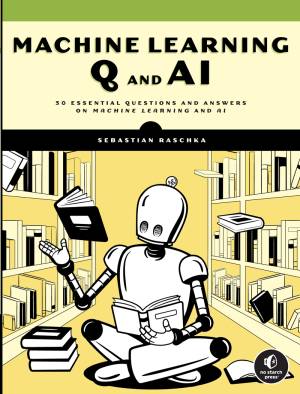
《Machine Learning Q and AI: 30 Essential Questions and Answers on Machine Learning and AI》
学习机器学习和人工智能领域30个前沿问题的答案,提升您的专业水平。
Learn the answers to 30 cutting-edge questions in machine learning and AI and level up your expertise in the field.
如果您准备好超越入门概念,深入探索机器学习、深度学习和人工智能,《机器学习问答与AI》采用问答形式,让您快速轻松地掌握知识,无需繁琐摸索。
If you’re ready to venture beyond introductory concepts and dig deeper into machine learning, deep learning, and AI, the question-and-answer format of Machine Learning Q and AI will make things fast and easy for you, without a lot of mucking about.
本书源于作者塞巴斯蒂安·拉斯卡的常见问题,其直接务实的风格使高级主题更易理解且引人入胜。
Born out of questions often fielded by author Sebastian Raschka, the direct, no-nonsense approach of this book makes advanced topics more accessible and genuinely engaging.
每章以简洁独立的篇幅探讨人工智能的基本问题,通过清晰的解释、图表和实践练习逐步解析。
Each brief, self-contained chapter journeys through a fundamental question in AI, unraveling it with clear explanations, diagrams, and hands-on exercises.
内容概要:重点章节:简明回答人工智能的关键问题,将复杂概念分解为易于消化的部分。
WHAT'S INSIDE: FOCUSED CHAPTERS: Key questions in AI are answered concisely, and complex ideas are broken down into easily digestible parts.
广泛主题:拉斯卡涵盖神经网络架构、模型评估到计算机视觉和自然语言处理等多种主题。
WIDE RANGE OF TOPICS: Raschka covers topics ranging from neural network architectures and model evaluation to computer vision and natural language processing.
实际应用:学习提升模型性能、微调大型模型等技术。
PRACTICAL APPLICATIONS: Learn techniques for enhancing model performance, fine-tuning large models, and more.
您还将探索如何:管理神经网络训练中的多种随机性、区分大语言模型的编码器与解码器架构、通过数据与模型调整减少过拟合、为分类器构建置信区间并在有限标注数据下优化模型、选择不同多GPU训练范式和各类生成式AI模型、理解自然语言处理的性能指标、解读视觉Transformer的归纳偏置。
You’ll also explore how to: • Manage the various sources of randomness in neural network training • Differentiate between encoder and decoder architectures in large language models • Reduce overfitting through data and model modifications • Construct confidence intervals for classifiers and optimize models with limited labeled data • Choose between different multi-GPU training paradigms and different types of generative AI models • Understand performance metrics for natural language processing • Make sense of the inductive biases in vision transformers If you’ve been on the hunt for the perfect resource to elevate your understanding of machine learning, Machine Learning Q and AI will make it easy for you to painlessly advance your knowledge beyond the basics.
如果您一直在寻找提升机器学习认知的理想资源,《机器学习问答与AI》将助您轻松突破基础,进阶学习。
✍️ 这本书把机器学习和AI中最让人困惑的问题拎出来,用问答形式一个个拆解。作者Raschka是领域内真正做事的人,没有那些华而不实的包装,答案直接、清晰、不绕弯子。适合刚入行或者想系统补基础知识的人。不过如果你已经有扎实基础,可能觉得太浅了。总的来说,一本实用的工具书,读完能帮你建立正确的理解框架。
📌 重点单词
| 单词 | 音标 | 词性 | 中文 | 等级 |
|---|---|---|---|---|
| cutting-edge | /ˌkʌtɪŋˈeɪdʒ/ | adj. | 尖端的,前沿的 | IELTS |
| venture | /ˈventʃə(r)/ | v. | 冒险进入,敢于涉足 | CET6 |
| accessible | /əkˈsesəbl/ | adj. | 易懂的,可接近的 | CET4 |
| digestible | /ˈdʒestəbl/ | adj. | 易懂的,易消化的 | CET6 |
| paradigm | /ˈpærədaɪm/ | n. | 范式,典型模式 | TEM8 |
| overfitting | /ˌəʊvəˈfɪtɪŋ/ | n. | 过拟合 | 其他 |
| fine-tune | /ˌfaɪnˈtjuːn/ | v. | 微调 | 其他 |
| invariant | /ɪnˈveəriənt/ | n./adj. | (归纳)偏置;不变的 | 其他 |
🔗 重点短语
- level up — 提升,升级 — She wants to level up her English skills by reading academic papers.(她想通过阅读学术论文来提升英语水平。)
- dig deeper — 深入探究 — We need to dig deeper into the data to find the root cause.(我们需要更深入地研究数据以找到根本原因。)
- mucking about — 瞎忙活,浪费时间 — Stop mucking about and get back to work.(别瞎混了,回去工作。)
- break down — 分解,拆分为小部分 — The teacher broke down the complex theory into simple steps.(老师将复杂的理论分解为简单的步骤。)
- make sense of — 理解,弄懂 — It took me weeks to make sense of the transformer architecture.(我花了几周才弄懂 Transformer 架构。)
💬 短句 / Idiom
- no-nonsense approach — 务实直白的风格;不搞虚招的做法 — 形容一种直接、高效、拒绝繁文缛节的风格。
- born out of… — 源于……;由……而产生 — 常用于说明某事物产生的背景或原因,如 The idea was born out of years of teaching experience.
- on the hunt for… — 在寻找……;正在搜寻…… — 表示积极寻找某物的习语,带有目的性和热情。
🧩 语法点
- if 引导的条件状语从句 + 祈使句结构 — If you're ready to venture beyond introductory concepts…, the question-and-answer format … will make things fast and easy for you. — if 从句提出条件,主句用将来时给出结果,表达"如果……就……"的逻辑关系。
- 过去分词短语作后置定语 — …questions often fielded by author Sebastian Raschka… — fielded 是过去分词,相当于省略了 which were 的定语从句,修饰前面的 questions。
- range from A to B — 表示范围的固定搭配 — Raschka covers topics ranging from neural network architectures and model evaluation to computer vision and natural language processing. 其中 ranging from…to… 是现在分词短语作后置定语,修饰 topics。
FIN